Love this? Save it for later!
Share the inspiration with your friends
I claimed to hate anise for the better part of a decade. A whole ten years. I’d pick it out of cookies, turn down biscotti, and eye any bottle of ouzo with deep suspicion. Then last October, my neighbor Rosa knocked on my door holding a bread basket wrapped in a kitchen towel, still warm. “Just for you,” she said, and I could smell it through the cloth — that sweet, floral scent of orange and something else I couldn’t quite place. I took a bite standing in my doorway, ready to be polite and move on. Instead, I stood there, chewing, and then took another bite. And another. By the time I looked up, Rosa was grinning. “That’s the anise,” she said. “You like it.” I didn’t even argue.
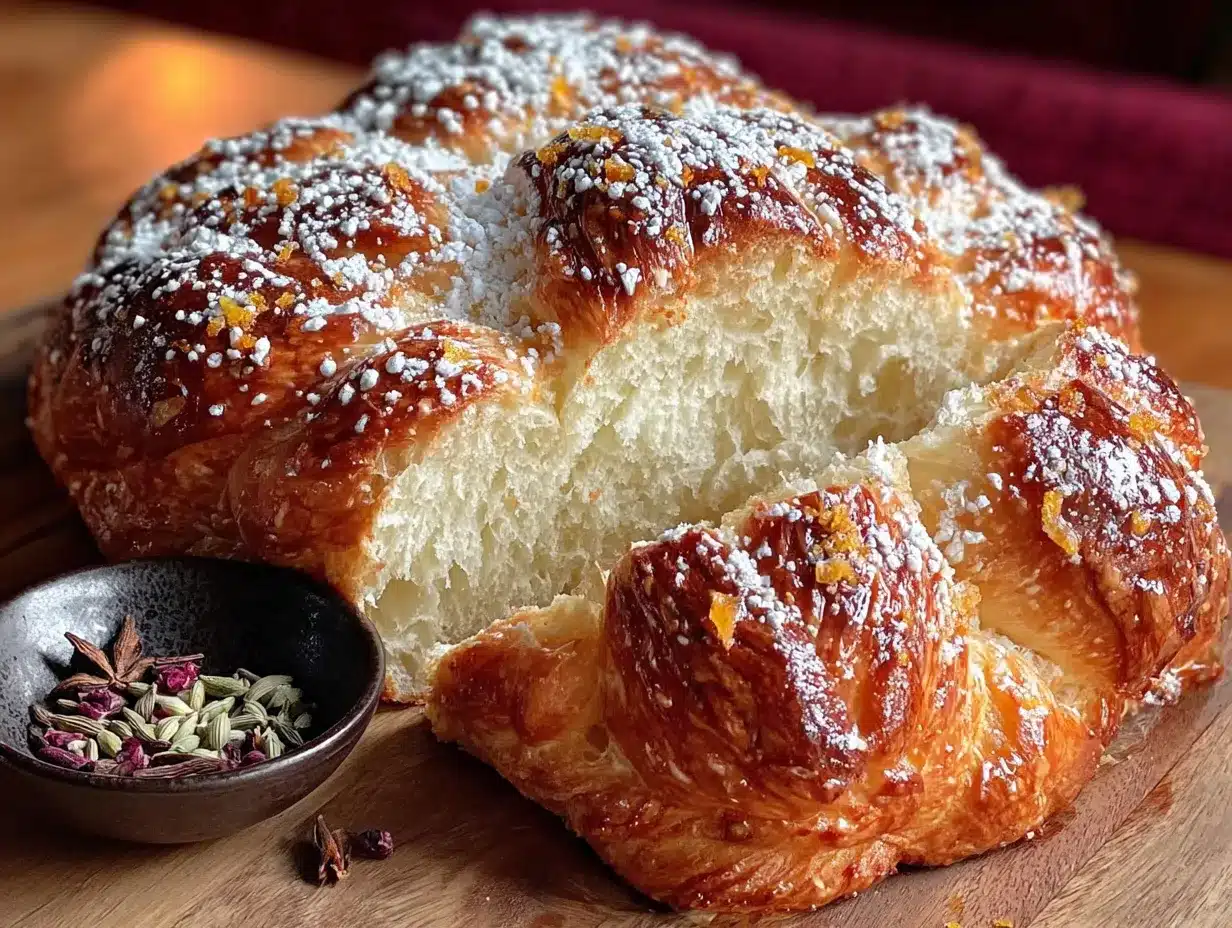
Honestly, I think that’s the magic of this homemade Pan de Muerto with Orange Zest and Anise. It doesn’t hit you over the head with any single flavor. The anise is there, sure, but it’s working in the background, warming things up, making the orange taste brighter and the bread feel cozier. It’s the kind of quiet surprise that changes your mind without you even noticing until you’re halfway through your second slice. Maybe you’ve been there — that moment when a food you thought you knew turns out to be something completely different.
I’ve been making this bread every Día de Muertos since that day, and somewhere along the way, it stopped being just a holiday bread and started being a regular thing I make when I want to feel like I’ve got my kitchen figured out. The dough is forgiving, the aroma fills the whole house, and my kids actually fight over the orange-sugar topping. Let me tell you, getting picky eaters to fight over bread with anise in it? That’s a win I didn’t see coming.
Why You’ll Love This Recipe
This isn’t just another holiday bread recipe. It’s the one that makes you look like you spent all day in the kitchen when really, you just followed a few simple steps and let the yeast do the heavy lifting. I’ve tested this version at least seven times — yes, seven — tweaking the orange zest amount, the anise timing, the butter temperature. My family has been very patient taste-testers, and this is the version that finally got unanimous thumbs up from everyone, including my dad who “doesn’t do sweet breads.”
- Simple Ingredients : No trips to a specialty Mexican market required. All-purpose flour, butter, eggs, orange, anise seeds — these are things you can find at any regular grocery store. I buy my anise seeds in the spice aisle for under three bucks.
- Budget-Friendly : This whole loaf costs about four dollars to make. Compare that to the twelve bucks you’d pay at a bakery, and you’re saving money while getting a better, fresher result.
- Family-Approved : The orange sweetness wins over kids, and the subtle anise warmth wins over adults. It’s the rare bread that pleases a whole table of different tastes.
- Freezes Beautifully : Make it ahead, freeze it, and pull it out when you need a quick dessert or breakfast. It thaws like a dream.
- Forgiving Dough : If you’re nervous about yeast breads, this one is a good place to start. The dough is soft and easy to work with, and it rises reliably even in a slightly cool kitchen.
What makes this recipe different from the rest is the double hit of orange. You’re putting zest right into the dough, and then you’re brushing the baked bread with melted butter and dipping it in an orange-sugar mixture. That second layer of citrus makes the flavor pop in a way that one round of zest just can’t do. Plus, the anise seeds get toasted briefly in a dry pan before going into the dough, which wakes up their flavor and keeps them from being too sharp.
This is the kind of bread that makes you close your eyes after the first bite. It’s soft, almost brioche-like, with a crumb that tears beautifully. It’s comfort food with a little bit of sophistication, and it costs pennies to make. That’s the kind of math I can get behind.
What Ingredients You Will Need
This recipe uses simple, everyday ingredients to create something that tastes anything but ordinary. Most of these are pantry staples, and the few that aren’t — like anise seeds — are easy to find and inexpensive. Here’s what you’ll need:
For the Dough
- 4 cups all-purpose flour (500 grams) — I use Gold Medal or King Arthur. No need for bread flour here; all-purpose gives the perfect tender crumb.
- 1/2 cup granulated sugar (100 grams)
- 1 packet active dry yeast (2 1/4 teaspoons) — I prefer Fleischmann’s or Red Star. Make sure it’s not expired, or your bread won’t rise properly.
- 1/2 teaspoon salt
- 1 teaspoon anise seeds — Lightly toasted in a dry pan until fragrant. This takes about 60 seconds. Don’t skip this step; it makes a real difference.
- Zest of 2 large oranges — About 2 tablespoons. Use a microplane for the best texture. Avoid the white pith, which is bitter.
- 1/2 cup unsalted butter (113 grams), softened — Let it sit out for at least an hour before starting. Cold butter won’t incorporate properly.
- 3 large eggs, room temperature — If you forgot to take them out, place them in a bowl of warm water for 5 minutes.
- 1/2 cup warm milk (120 ml), around 110°F — Whole milk gives the richest result, but 2% works fine too.
- 1 teaspoon vanilla extract — Pure vanilla if you have it, but imitation works in a pinch.
For the Topping
- 1/4 cup unsalted butter (56 grams), melted
- 1/4 cup granulated sugar (50 grams)
- Zest of 1 orange — Mixed into the sugar. This is the secret to that bright, citrusy coating.
A quick note on the anise: if you really can’t find it or someone in your family is dead set against it, you can leave it out. The bread will still be delicious — just more of a straightforward orange sweet bread. But honestly, the anise is what makes this taste like the real thing. It’s subtle, not licorice-forward at all. My kids didn’t even notice it was there.
For the orange zest, I recommend using organic oranges if you can. Since you’re using the peel, you want to avoid any wax or pesticide residue. If conventional is all you’ve got, give them a good scrub under hot water and dry them well before zesting.
Equipment Needed
You don’t need a fancy kitchen to make this bread. Here’s what I use:
- Large mixing bowl — Glass or stainless steel works best. Plastic can hold onto odors.
- Stand mixer with dough hook — This makes kneading much easier, but you can absolutely do it by hand. It’ll take about 10 minutes of arm work.
- Small skillet — For toasting the anise seeds. Any small pan works.
- Microplane or fine grater — For zesting the oranges. A box grater works too, but the zest won’t be as fine.
- Baking sheet — A standard half-sheet pan lined with parchment paper.
- Pastry brush — For brushing the melted butter on the baked bread. A silicone one is easiest to clean.
- Clean kitchen towel — For covering the dough while it rises. A lightweight cotton towel is perfect.
- Cooling rack — So the bread doesn’t get soggy on the bottom.
If you don’t have a stand mixer, don’t worry. I made this bread by hand for years before I got my KitchenAid. It’s a good arm workout, and honestly, there’s something satisfying about feeling the dough come together under your hands. Just make sure you knead until it’s smooth and elastic — about 8 to 10 minutes of steady work.
One tip: if you’re using a stand mixer, keep an eye on it. The dough can climb up the hook if you walk away. I learned that the hard way and ended up with flour all over my counter.
Preparation Method
Let me walk you through this step by step. It looks like a lot, but I promise it’s straightforward once you get going.
Step 1: Toast the anise seeds. Place the anise seeds in a small dry skillet over medium heat. Shake the pan gently for about 60 seconds, until you can smell them. They should be fragrant but not browned. Pour them onto a plate to cool completely while you prep everything else.
Step 2: Activate the yeast. In a small bowl, combine the warm milk (110°F — it should feel like warm bath water) with 1 tablespoon of the sugar and the yeast. Stir gently and let it sit for 5 to 10 minutes. It should get foamy and bubbly on top. If it doesn’t, your yeast might be dead. Start over with fresh yeast.
Step 3: Mix the dry ingredients. In your large mixing bowl, whisk together the flour, remaining sugar, salt, and the cooled toasted anise seeds. Add the orange zest and rub it into the flour with your fingers until it’s evenly distributed. This releases the oils and makes the flavor stronger.
Step 4: Combine the wet ingredients. In a separate bowl, whisk together the eggs, vanilla extract, and the yeast mixture. Don’t worry if it looks a little lumpy.
Step 5: Bring it together. Make a well in the center of the flour mixture. Pour in the egg mixture and the softened butter. If you’re using a stand mixer, use the dough hook on low speed for about 2 minutes, until a shaggy dough forms. If you’re doing it by hand, use a wooden spoon until it’s too stiff, then get in there with your hands.
Step 6: Knead the dough. Increase the mixer speed to medium and knead for 6 to 8 minutes. The dough should pull away from the sides of the bowl and feel smooth and elastic. If it’s too sticky, add flour one tablespoon at a time. If it’s too dry, add a teaspoon of milk. By hand, knead on a lightly floured surface for 8 to 10 minutes. You’ll know it’s ready when you can stretch a small piece of dough thin enough to see light through it without it tearing — that’s the windowpane test.
Step 7: First rise. Shape the dough into a ball and place it in a lightly greased bowl. Cover with a clean kitchen towel and let it rise in a warm, draft-free spot for about 1 1/2 to 2 hours, until doubled in size. I put mine in the microwave with the door cracked — it stays warm and draft-free. If your kitchen is cold, it might take closer to 2 1/2 hours. Be patient.
Step 8: Shape the bread. Punch the dough down gently to release the air. Turn it out onto a lightly floured surface. Cut off about a quarter of the dough and set it aside. Shape the larger piece into a round loaf and place it on your parchment-lined baking sheet. Divide the reserved dough into small pieces — you’ll use these to make the bone shapes. Roll them into ropes about 4 inches long, then shape them into little bones or rounds. Place them on top of the loaf in a cross pattern or whatever design you like. Traditional Pan de Muerto has bone shapes on top, but honestly, I’ve done stars and hearts too. Cover loosely with the towel and let it rise again for 45 minutes to 1 hour.
Step 9: Bake. Preheat your oven to 350°F. Bake the bread for 25 to 30 minutes, until the top is deep golden brown and the loaf sounds hollow when you tap the bottom. If the top is browning too fast, tent it loosely with foil for the last 10 minutes.
Step 10: The finishing touch. While the bread is still warm, brush the entire surface with melted butter. Mix the remaining 1/4 cup sugar with the zest of one orange. Sprinkle this mixture generously all over the buttered bread. Let it cool on the baking sheet for 10 minutes, then transfer to a cooling rack.
The hardest part is waiting for it to cool enough to slice. I always end up burning my fingers on the first piece because I can’t wait.
Cooking Tips & Techniques
I’ve made this bread more times than I can count, and I’ve made every mistake in the book. Here’s what I’ve learned:
Temperature matters more than you think. If your milk is too hot, it will kill the yeast. If it’s too cold, the yeast won’t activate. 110°F is the sweet spot. I use an instant-read thermometer, but if you don’t have one, test it on your wrist — it should feel warm but not hot, like comfortable bath water.
Don’t skip the anise toasting. Raw anise seeds can be harsh and almost medicinal. Toasting them for just a minute mellows them out and brings out a warm, almost sweet flavor. I forgot to toast them once, and the bread had this sharp edge that didn’t feel right. My husband asked if I’d added black licorice. Never again.
Let the butter soften properly. I know the temptation to microwave it — I’ve done it too. But melted butter changes the dough texture. If you forgot to set it out, cut it into small cubes and let it sit for 15 minutes. That’s faster than microwaving and won’t mess up your dough.
Watch your rise times. Under-risen dough gives you dense, heavy bread. Over-risen dough can collapse in the oven. I set a timer and check it at the minimum time. If it’s not doubled yet, I give it another 15 minutes. The dough should be puffy and hold a gentle fingerprint when you poke it.
The orange sugar is the star. Don’t skimp on it. Brush the butter on while the bread is still warm so the sugar sticks. And zest the orange right into the sugar — the oils will perfume the sugar and make it taste brighter. I’ve tried pre-zesting and letting it sit, but it’s not the same.
Variations & Adaptations
One of the great things about this bread is how flexible it is. Here are some ways to make it your own:
Citrus swap. If orange isn’t your thing, use lemon or lime zest instead. The flavor will be different — brighter and more tart — but it’s still delicious. I made a lemon version for a friend who doesn’t love orange, and she asked for the recipe twice.
Spice it up. Add a teaspoon of ground cinnamon or cardamom to the flour mixture. It gives the bread a warm, almost chai-like flavor that pairs beautifully with the orange. I did this one year when I ran out of anise, and it became a new favorite.
Dairy-free version. Use plant-based butter and oat milk or almond milk. The texture will be slightly different — a little less tender — but it still works. I’ve tested this with Miyoko’s butter and oat milk, and my dairy-sensitive niece couldn’t tell the difference.
Gluten-free adaptation. I’ll be honest — this one is tricky. Gluten-free flour blends don’t behave the same way. If you need a gluten-free version, look for a blend that includes xanthan gum and expect a denser crumb. I’ve had mixed results, so I usually make this for gluten-eating friends and make something else for my gluten-free ones.
Add a filling. Some people like to stuff this bread with a sweet filling. You can roll the dough out, spread it with a thin layer of dulce de leche or cinnamon sugar, then shape it into a loaf. It’s not traditional, but it’s really good.
Serving & Storage Suggestions
This bread is best served warm, the same day you bake it. The texture is soft and almost pillowy, and the orange sugar coating is still a little crunchy. I like to serve it with a cup of strong coffee or Mexican hot chocolate. The bitterness of the coffee balances the sweetness of the bread perfectly.
If you’re serving it for Día de Muertos, present it on a nice plate or a bread basket lined with a colorful cloth. It’s a beautiful bread on its own, so you don’t need much decoration. A few marigold petals around the plate would be lovely, but that’s optional.
Storage: Keep the bread in an airtight container at room temperature for up to 3 days. The coating will soften over time, but the flavor actually gets better on day two. I’ve kept it in a paper bag on the counter, and it stays fresh for about 2 days that way.
Freezing: This bread freezes beautifully. Wrap it tightly in plastic wrap, then in foil, and freeze for up to 3 months. To thaw, leave it on the counter for a few hours or warm it in a 300°F oven for 10 minutes. I usually make two loaves at a time — one for now, one for later.
Reheating: If you’re eating it the next day, pop slices in the toaster or warm them in a 350°F oven for 5 minutes. It brings back that fresh-baked softness. The microwave works in a pinch, but it can make the bread chewy.
One thing I’ve noticed — the orange flavor mellows out after day one. If you want that bright citrus punch, add a little extra zest to the sugar coating right before serving.
Nutritional Information & Benefits
Let’s be real — this is a sweet bread made with butter, sugar, and eggs. It’s a treat, not a health food. But that doesn’t mean it’s without merit. Here’s a rough breakdown per serving (1/8 of the loaf):
- Calories: Approximately 320
- Fat: 14g
- Carbohydrates: 44g
- Protein: 6g
- Fiber: 1g
- Sugar: 18g
On the plus side, the orange zest provides a small amount of vitamin C and antioxidants. Anise seeds have been used in traditional medicine for digestion and have anti-inflammatory properties. The eggs add protein and healthy fats. And honestly, there’s something to be said for the mental health benefits of baking — the process is meditative, and sharing food with loved ones is good for the soul.
If you’re watching your sugar, you can reduce the sugar in the dough to 1/3 cup without affecting the texture too much. The topping is harder to reduce since it’s what gives the bread its signature look and flavor. You could skip the topping and just brush with butter, but it won’t be the same.
This bread contains gluten, dairy, and eggs, so it’s not suitable for those with allergies to those ingredients. I’ve included dairy-free options in the variations section.
Conclusion
This homemade Pan de Muerto with Orange Zest and Anise is the bread that changed my mind about anise, and it might just become a new tradition in your kitchen too. It’s affordable, approachable, and genuinely delicious — the kind of recipe that makes you feel like a real baker without requiring a culinary degree.
I hope you give it a try, whether it’s for Día de Muertos, a weekend baking project, or just a Tuesday when you want your house to smell amazing. Play with the flavors, make it your own, and don’t stress about perfection. The first time I made this, my bone shapes looked more like sad worms, and it still tasted incredible.
If you make this recipe, I’d love to hear about it. Leave a comment below and let me know how it turned out — did you add any twists? Did your family love it? Did you also burn your fingers on the first slice? Share your stories, and don’t forget to pin this recipe for later. Happy baking, friends!
Frequently Asked Questions
Can I make this bread without a stand mixer?
Absolutely. I made it by hand for years. It takes a little more effort — about 8 to 10 minutes of kneading — but it’s totally doable. The dough is soft and forgiving, so it’s a good one to practice your kneading technique on.
Why didn’t my dough rise?
Most likely, your yeast was dead or your milk was too hot. Check the expiration date on your yeast, and make sure your milk is around 110°F. If your kitchen is cold, try letting the dough rise in a slightly warm oven (turn it on to 200°F for 2 minutes, then turn it off and put the dough inside).
Can I skip the anise seeds?
You can, but the bread won’t taste like traditional Pan de Muerto. The anise is subtle — it’s more of a background warmth than a strong flavor. If you’re really not a fan, try substituting 1/2 teaspoon of ground cinnamon or cardamom instead.
How do I get the bone shapes right?
Honestly, they don’t have to be perfect. Roll small pieces of dough into ropes about 4 inches long, then flatten the ends slightly. Place them on top of the loaf in a cross pattern. If they look a little wonky, that’s fine — it’s homemade bread, not a bakery display. The taste is what matters.
Can I double this recipe?
Yes, but I recommend making two separate batches rather than doubling it in one bowl. The yeast and mixing times can get tricky with larger quantities. Plus, two loaves mean one for now and one for the freezer — and future you will be very grateful.
Pin This Recipe!
Best Easy Homemade Pan de Muerto with Orange Zest

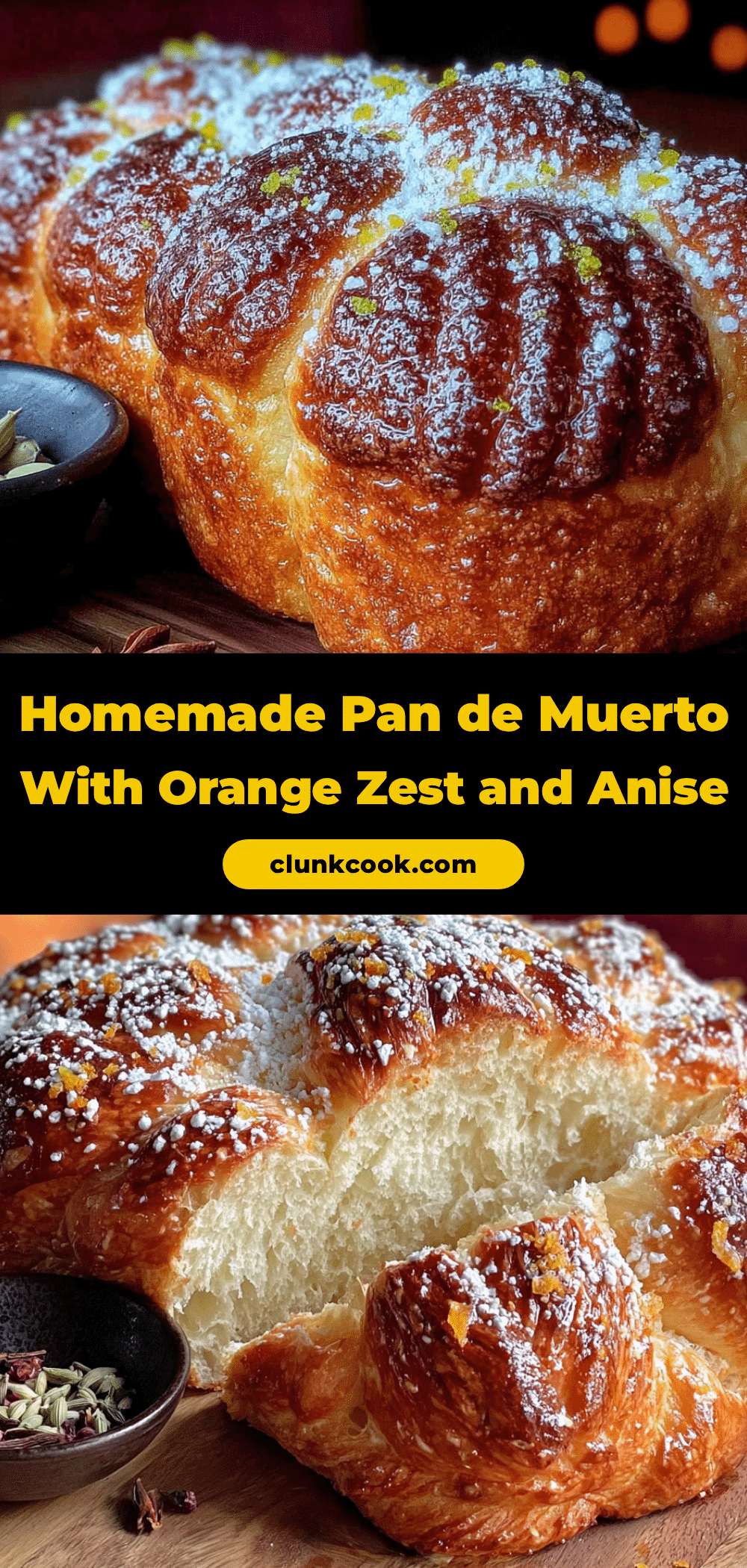
This homemade Pan de Muerto with Orange Zest and Anise is a soft, brioche-like bread with a bright citrus coating and subtle warmth from toasted anise seeds. It’s budget-friendly, family-approved, and perfect for Día de Muertos or any day you want your kitchen to smell amazing.
- Prep Time: 30 minutes
- Cook Time: 30 minutes
- Total Time: 3 hours (including rising time)
- Yield: 8 servings 1x
- Category: Bread
- Cuisine: Mexican
Ingredients
- 4 cups all-purpose flour (500 grams)
- 1/2 cup granulated sugar (100 grams)
- 1 packet active dry yeast (2 1/4 teaspoons)
- 1/2 teaspoon salt
- 1 teaspoon anise seeds, lightly toasted
- Zest of 2 large oranges (about 2 tablespoons)
- 1/2 cup unsalted butter (113 grams), softened
- 3 large eggs, room temperature
- 1/2 cup warm milk (120 ml), around 110°F
- 1 teaspoon vanilla extract
- 1/4 cup unsalted butter (56 grams), melted (for topping)
- 1/4 cup granulated sugar (50 grams) (for topping)
- Zest of 1 orange (for topping)
Instructions
- Toast the anise seeds in a small dry skillet over medium heat for about 60 seconds until fragrant. Pour onto a plate to cool completely.
- In a small bowl, combine warm milk (110°F) with 1 tablespoon of the sugar and the yeast. Let sit for 5-10 minutes until foamy.
- In a large mixing bowl, whisk together flour, remaining sugar, salt, and cooled toasted anise seeds. Add orange zest and rub into flour with fingers until evenly distributed.
- In a separate bowl, whisk together eggs, vanilla extract, and the yeast mixture.
- Make a well in the center of the flour mixture. Pour in the egg mixture and softened butter. Mix with a dough hook on low speed for 2 minutes (or by hand with a wooden spoon) until a shaggy dough forms.
- Knead on medium speed for 6-8 minutes (or by hand on a lightly floured surface for 8-10 minutes) until smooth and elastic. Dough should pass the windowpane test.
- Shape dough into a ball and place in a lightly greased bowl. Cover with a clean kitchen towel and let rise in a warm, draft-free spot for 1 1/2 to 2 hours until doubled in size.
- Punch down dough gently. Turn out onto a lightly floured surface. Cut off about a quarter of the dough and set aside. Shape the larger piece into a round loaf and place on a parchment-lined baking sheet. Divide reserved dough into small pieces, roll into 4-inch ropes, and shape into bones or rounds. Place on top of loaf in a cross pattern. Cover loosely and let rise for 45 minutes to 1 hour.
- Preheat oven to 350°F. Bake for 25-30 minutes until deep golden brown and loaf sounds hollow when tapped on the bottom. Tent with foil if browning too fast.
- While bread is still warm, brush entire surface with melted butter. Mix remaining 1/4 cup sugar with zest of one orange and sprinkle generously over buttered bread. Let cool on baking sheet for 10 minutes, then transfer to a cooling rack.
Notes
The anise is subtle and not licorice-forward; toasting it mellows the flavor. For the best orange flavor, use organic oranges and zest right before using. The dough is forgiving and rises reliably even in a slightly cool kitchen. The bread freezes beautifully for up to 3 months.
Nutrition
- Serving Size: 1 slice (1/8 of loaf
- Calories: 320
- Sugar: 18
- Sodium: 180
- Fat: 14
- Saturated Fat: 8
- Carbohydrates: 44
- Fiber: 1
- Protein: 6
Keywords: Pan de Muerto, Day of the Dead bread, orange bread, anise bread, Mexican sweet bread, holiday bread, homemade bread